Tova’s new questions about Erik’s last night
Remarkably Bright CreaturesTova Sullivan’s new questions about Erik Sullivan’s last night begin with a detail that seems small beside his disappearance: he may have been seeing a girl, and had planned to bring her to a cabin. But the girl’s absence from Tova’s knowledge makes the remembered night newly strange. Adam Wright’s incomplete recollection does not explain why Erik took a boat out or what happened afterward; it unsettles the story Tova thought she knew and leaves her searching for a name no one can provide.
The disclosure at the luncheon
At Mary Ann Minetti’s farewell luncheon in August, Tova arrives early at the Elland Chophouse, her ankle still tender after weeks in a boot. Adam recognizes her and recalls the last time he saw Erik: the two friends ate nachos at a snack bar that afternoon, before Erik went to work. They planned to go to Adam’s family cabin the following day. Erik, as usual, meant to sneak beers from Tova’s refrigerator, and also hoped to impress a girl by bringing her along.
The beer theft sounds entirely like her son to Tova; the girl does not. She cannot remember Erik having a girlfriend then. Adam qualifies what he knows: he is unsure what the relationship was called, but says the two were involved. His recollection supplies a new possibility, not a firm account. The girl has no name in his memory, and Tova is left with the sharpest part of the disclosure—the possibility that an important part of Erik’s life took place beyond her awareness.
Tova responds that she welcomes what people remember. That openness matters: she does not dismiss Adam’s account merely because it reaches her late or comes from a school friend who was not especially close to Erik. Yet accepting a memory is not the same as knowing how much to trust it. The luncheon gives her one more fragment of her son’s final day, while withholding the fact she most wants from it.
A past that does not quite fit
The new report sits uneasily beside the police inquiry Tova remembers. Because Erik was popular but selective about whom he dated, the police spoke at length with several of his former sweethearts, not as suspects but as people who might know what he had been doing that night. Ashley Barrington had taken him to a homecoming dance the previous autumn; she was away on a family cruise when he disappeared. Jenny-Lynn Mason, his prom date earlier that spring, was in Seattle for a social gathering and stayed overnight with a friend. Stephanie Lee, whom Tova had identified as a classmate who came to the house for supposed study dates, said she had been home asleep; a detective initially questioned that account but eventually established it was true. None could offer information about Erik’s last night.
Those interviews make the unnamed girl more, not less, troubling. Tova already knows the police looked among the people close to Erik, yet Adam’s recollection does not settle into any name she can recognize. She wonders whether she heard the girl’s name without attaching importance to it, whether it survives somewhere in her own memory, or whether Adam is even trying to remember. The missing name turns a general possibility into a puzzle with no reliable key.
Tova also examines the source of the clue. Adam had consumed several martinis at lunch; he was an old schoolmate, but not a close friend. He has only recently moved back to town and is absent from the phone book where she tries to look him up. She cannot know whether these circumstances weaken his memory or merely make it harder to check. Her doubt does not erase what he said. Instead, it gives the uncertainty another edge: she must reckon both with the girl and with the possibility that the story of the girl is incomplete or mistaken.
The question enters ordinary life
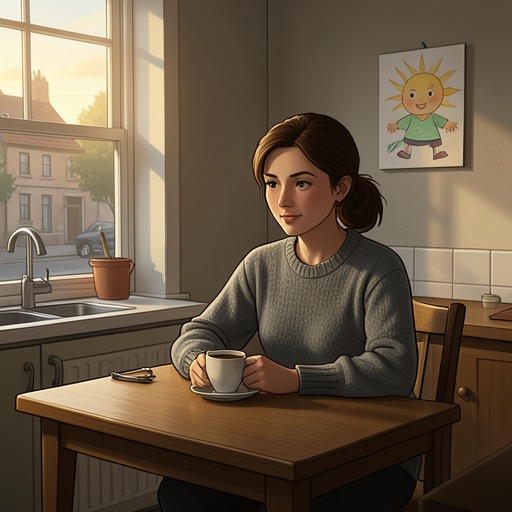
After the luncheon, the thought follows Tova through routines that had once seemed dependable. While making the bed, waiting for coffee, and dusting the baseboards on a Wednesday, she returns to the same fact: there was a girl. At the kitchen table, the five-letter crossword clue asks for a daredevil’s move. Tova knows the answer is STUNT, but her pencil wants to write A-G-I-R-L, or the girl’s name. The crossword makes the contrast visible: she can solve the printed clue, while the question that matters has no answer to enter.
The thought continues as she signs Jessica Snell’s paperwork, makes supper, and drives down the hill to the aquarium. The turn into the parking lot nearly catches her by surprise, though she has made it perhaps a thousand times. The girl has not changed the facts of Tova’s day; she has changed how easily Tova can inhabit them. A familiar route and a practiced task become vulnerable to distraction because the unanswered question keeps demanding attention.
When she works with Cameron Cassmore that evening, the two clean in silence. Tova fills a bucket with vinegar and water while Cameron rinses and wrings the mop. The scene places the new question amid the ordinary labor through which she keeps her life moving: even while working, her mind is occupied by what Erik did not tell her. The disclosure has no immediate answer to offer, but it has become difficult to set aside.
The future the clue opens
Sorting stored household things gives the question a different weight. Tova handles yellowing pillowcases embroidered by her mother and a sturdy linen apron her mother wore for baking. The objects had been kept to pass along someday, as part of a family inheritance carried down through generations. Looking at them, Tova imagines that, had Erik lived, the unnamed girl might have become a daughter-in-law. Tova might have taught her to make Erik’s favorite butter cookies and eventually passed the apron on to her.
That imagined future is not evidence that the girl would have become part of the family. It shows what Tova’s new knowledge touches: not only an unexplored part of Erik’s past, but a branch of family life that never had the chance to grow. Tova tries to stop herself from making too much of the possibility, reasoning that Erik had not cared enough about the girl to mention her. The thought stings. Her conclusion is understandable, but it cannot answer why he kept the relationship from her, or whether silence meant what she fears it meant.
Elsewhere, Tova picks at a peeling edge of Formica on the kitchen table and wonders why everything seems to be coming apart at the seams. Watching Cat leap at a horsefly beyond the window, pawing at glass it cannot cross, she recognizes the misery of knowing something is there and being unable to grasp it. The image gives her questions a physical shape: the girl is present in Adam’s account, but separated from Tova by a barrier of lost time and failing memory.
The questions remain open in the available account. Tova wonders why Erik took the boat out, why Adam cannot remember the girl’s name, and why Erik never told her about the girl. Adam’s recollection changes the emotional landscape of Erik’s last night without resolving the disappearance itself. What had been an absence becomes an absence with a new outline—and, for Tova, a new set of reasons to keep looking back.